Adapting User Generated Content To Emerging User Behaviors
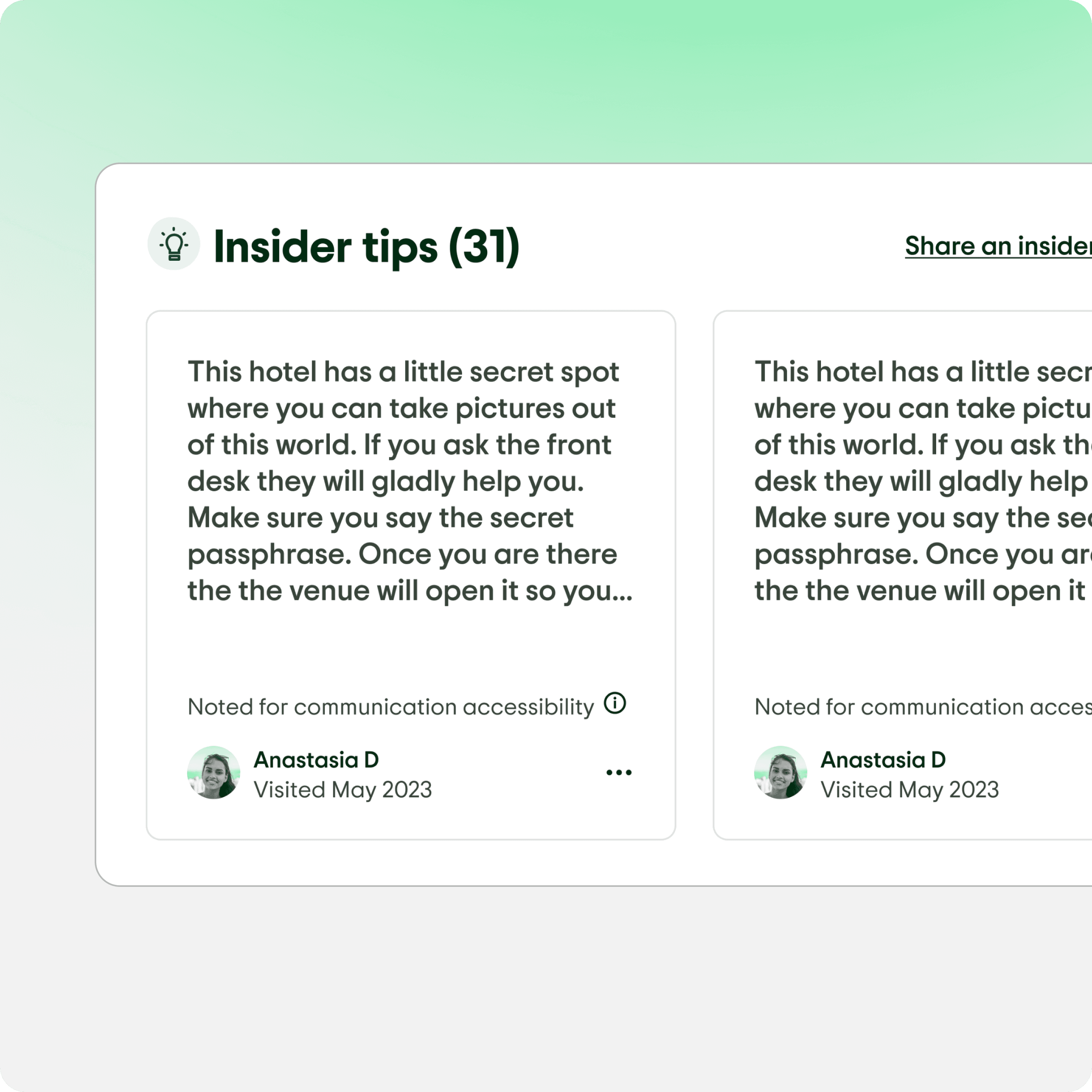
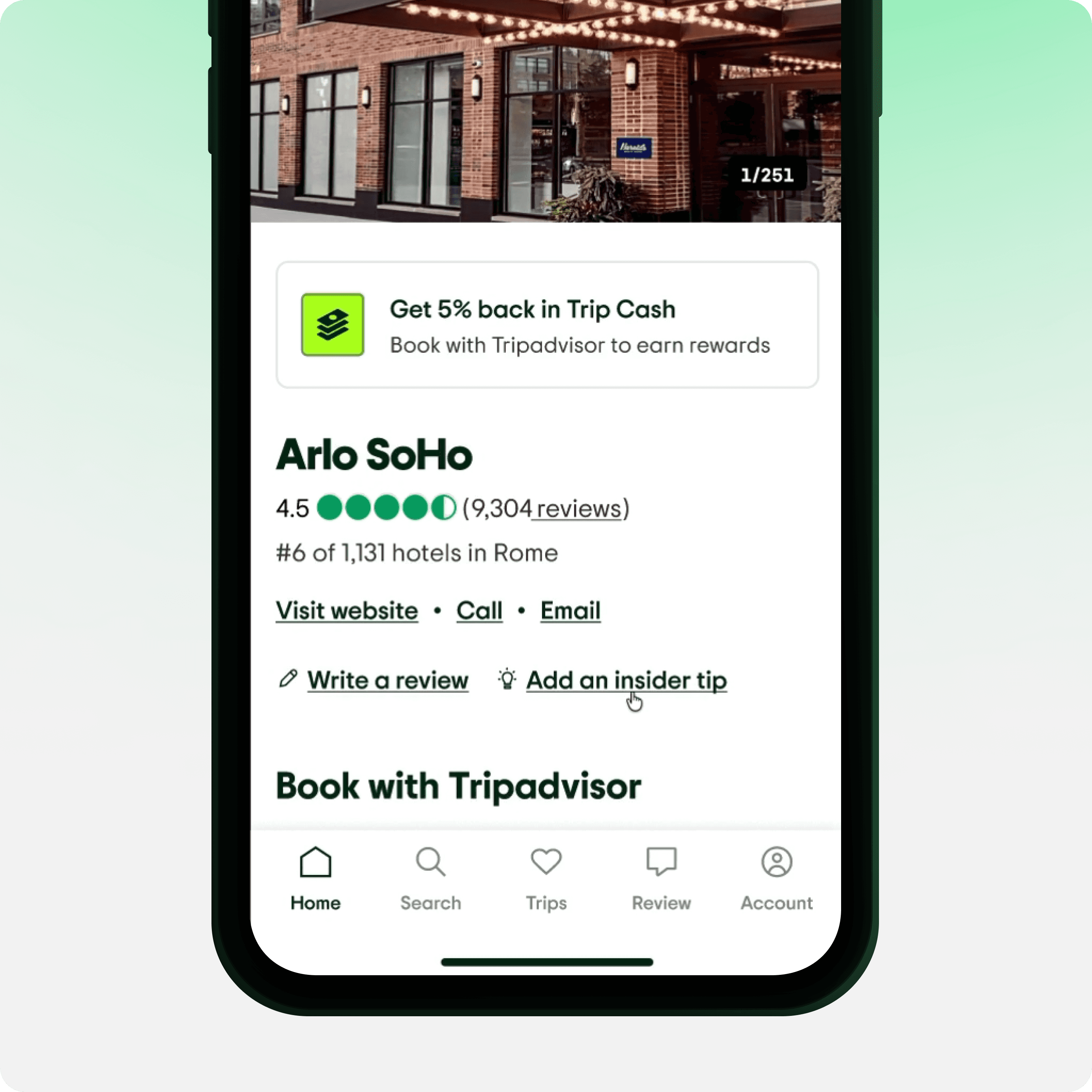
Introduced a new user-generated content format for passionate travelers, designed to help others make better travel decisions while lowering the barrier to contribution.

Needham, MA
2000
Travel
$1.79 billion (2023)
5,000+
Challenge
Tripadvisor faced a gradual decline in review rates, largely due to the multiple steps required to submit a review. Our goal was to create a way to encourage helpful UGC with a lower barrier to entry, boosting contribution rates without duplicating existing content.
Results
The introduction of Insider Tips drove an 8% increase in overall contribution rates, with traffic scaling predictably alongside the rollout cadence.
8%
Increased contribution rate
1.5%
Increased Tip initiation MoM
Business Bread & Butter
For years, Tripadvisor’s core value has been rooted in long-form, high-quality reviews that help travelers make confident, informed decisions. These reviews are the backbone of trust on the platform and a primary driver of user retention and monetization.
Aligning New User Behaviors And Business Goals
To address this, I partnered closely with Product and Research to explore how we could enable new contribution behaviors without cannibalizing existing review metrics. Through user research and competitive analysis, we identified opportunities to let travelers start with smaller, lower-commitment actions that still generated meaningful value for the ecosystem.
These early interactions were intentionally designed as on-ramps helping users build confidence, establish habits, and gradually progress toward richer contributions over time. This approach allowed us to support immediate business goals while laying the foundation for a longer-term vision of how traveler participation could evolve across the platform.
An Idea Coming To Life
The project began with a high degree of ambiguity and multiple potential directions to explore. Rather than prematurely committing to a single solution, we intentionally cast a wide net developing five distinct concepts to test with travelers.
To evaluate these concepts objectively, we assessed each one across five key categories that aligned user value with business priorities. This framework allowed us to move beyond subjective preference and anchor decisions in measurable signals.
Among the concepts tested, Tips emerged as the strongest contender outperforming the others across three critical attributes: likelihood to create content, likelihood to consume content, and overall alignment with the Tripadvisor brand. These results gave us confidence that Tips could lower the barrier to contribution while still reinforcing the platform’s core value proposition.
Turning Data & Constraints Into Design Opportunities
As the lead designer on Community, I shaped the experience from research signal to final interaction, making deliberate trade-offs when constraints required it. I navigated a fast-moving, high-visibility project by facilitating structured conversations, communicating changes early, and ensuring the team stayed grounded in user needs rather than reactive decision-making.
Looking Ahead For Community
After launch, I continued supporting the project alongside other priorities, focusing primarily on copy and visual refinements to the Tips flow. Tips was initially released to 1% of traffic for two weeks, then gradually ramped to 100% over the following two months. Because the new UGC format launched without formal marketing, we measured impact through organic adoption. Early signals were promising, with an increase in overall contribution rates; however, due to limited resources and shifting priorities, we chose not to further optimize the experience at that time.